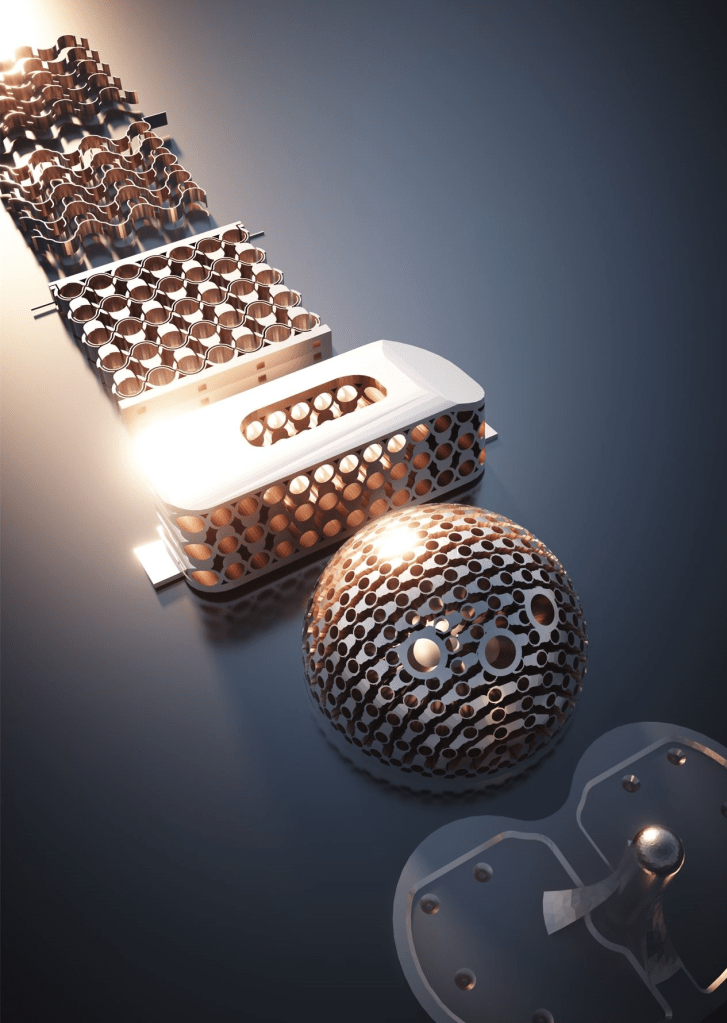
Our implants are being developed using a patented “meta-tribomaterial” technology originating from our research laboratory. Meta-tribomaterials are a new class of metamaterials with sensing and energy-harvesting capabilities. We are applying this technology to design metamaterial spinal fusion interbody implants that are patient-specific and 3D printable constructs. These implants are designed not only to match patient anatomy and bone density but also to incorporate a built-in nanogenerator that produces electrical signals under spine motion. This self-generated signal can be harnessed for empowering, monitoring, electrotherapy, and wireless communication. The implants are composed of conductive and dielectric microlayers that, when under pressure or force, undergo contact-electrification to create electric charges that relay information about healing progress to smartphones or other cloud-connectable devices in real-time.
Our metamaterial implants rely solely on their constituent components to achieve these functionalities, eliminating the need for external power sources, piezoelectric transducers, data loggers, or additional electronics. Rather than sacrificing implant space for external components, this approach preserves valuable surface area for bone on-growth and in-growth. We believe that meta-tribomaterial technology represents the next stage in the evolution of smart implantable devices, where scalable, cost-effective, multifunctional, and personalized implants could one day be widely adopted by clinicians to improve surgical outcomes.
Novuosis Scientific was recently selected to receive a $5,000 Boost Award from the Penn Wharton Innovation Fund in recognition of its innovative approach to spinal fusion diagnostics and commercialization potential. This non-dilutive funding supports advancement of our implant-integrated sensing platform and completion of key project milestones.

 Novuosis Scientific